1822
Difference Engine, "if a machine does the math, people don't die"
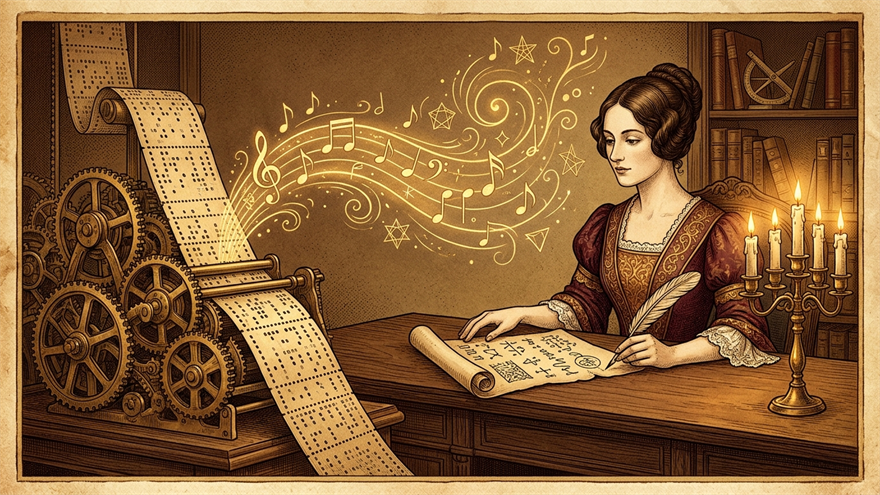
Back when ships sank because of faulty navigation tables, English mathematician Charles Babbage designed "a machine that handles numbers precisely with gears and levers."
It was the first dream of the real computer that would arrive 130 years later.
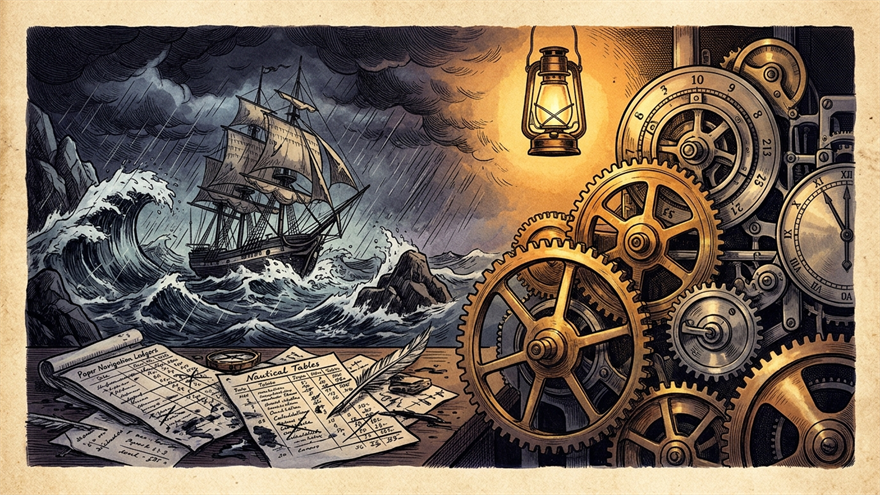
In 1820s Britain, sailors lived under a deadly threat. To know your position at sea you depended on thick books of star tables (nautical almanacs), and those tables were calculated by hand by humans.
People being people, typos and arithmetic errors crept in. Sailors trusted the bad numbers and ships ran aground.
Families who lost loved ones in shipwrecks grieved:
"Our son's ship sank because of a wrong number in the navigation table. A human calculation error took our boy."
A Cambridge mathematician named Charles Babbage sat staring at one of those error-riddled tables and had an audacious idea.
"Humans make mistakes because we're calculating by hand. What if a machine did it instead? Build a device of gears and levers that handles numbers with mechanical precision and it will never make a mistake."
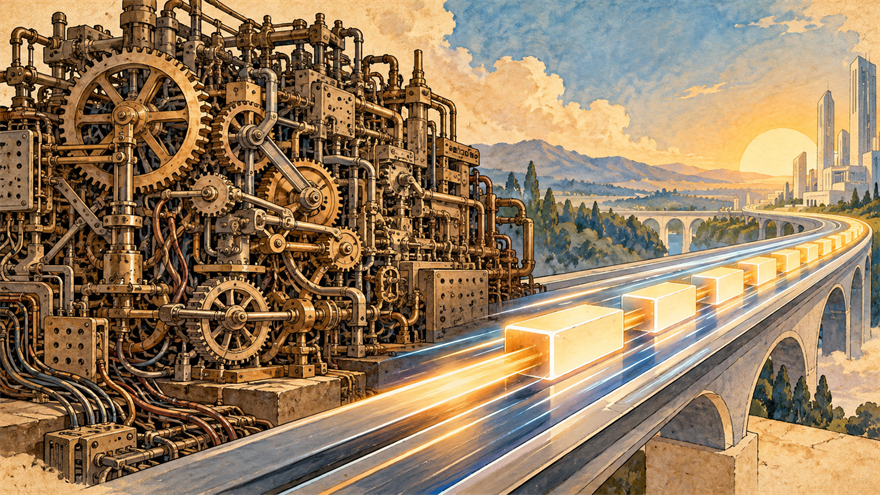
In 1822 he published the design for the Difference Engine — a colossal machine of tens of thousands of precisely meshed gears that would automatically perform polynomial calculations (complex formulas made by adding and subtracting powers of numbers). The British government recognized the value of the idea and funded it.
Fellow mathematicians welcomed the plan:
"If this machine gets built, we can automate the navigation tables. Human errors will disappear, and we'll save countless sailors' lives!"
Tragically, the precision metalwork required exceeded what was feasible at the time, and Babbage never managed to finish a complete machine in his lifetime.
The Difference Engine still mattered enormously.
It was the first serious attempt at the idea that "a machine can do calculation in our place" — the direct ancestor of the real computers that would arrive 130 years later.
In 1991 the Science Museum in London actually built the engine from Babbage's original drawings, and it worked perfectly.
Babbage was a genius far ahead of his time; his era's manufacturing simply couldn't keep up with him. The first dream of "computer" was born in Britain in 1822.
The Difference Engine designed by Charles Babbage was a mechanical automatic calculator meant to eliminate human mistakes in navigation, astronomy, and mathematical tables.
By breaking complicated polynomial equations down into repeated steps of addition (the method of finite differences), it turned precision metal gears to calculate and print results automatically.
Even though nineteenth-century metalwork could not finish the full machine, the design pioneered the core principle of automating calculation with hardware.